

By Iniubong Sam
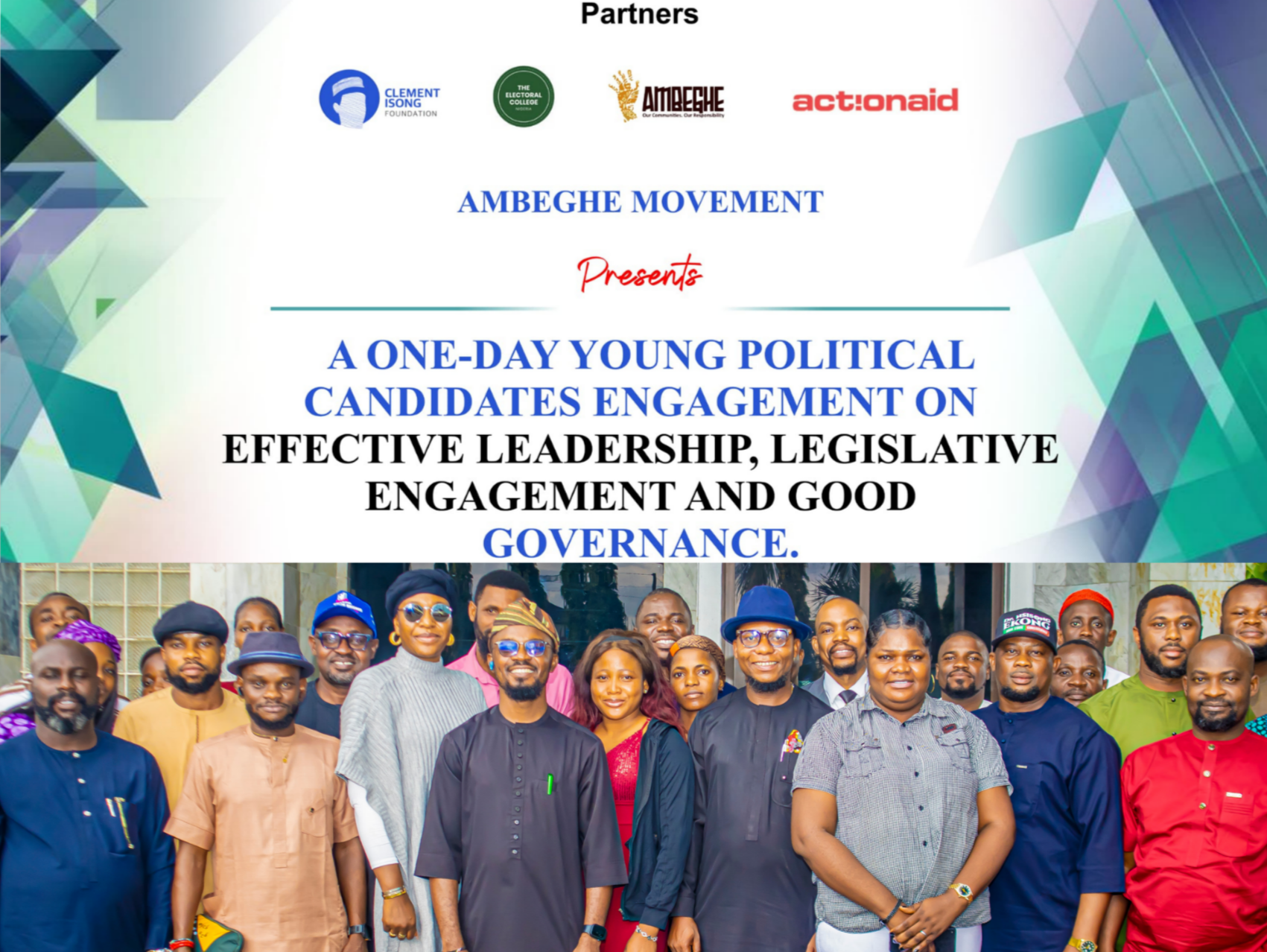
A three-phase action plan aimed at increasing youth participation in governance, combating vote-buying and promoting ethical leadership has emerged from the Young Political Candidates Engagement on Effective Leadership, Legislative Engagement and Good Governance held in Uyo, Akwa Ibom State.
The action plan, contained in a communiqué issued at the end of the one-day engagement held on Friday, July 31, 2026, outlines short, medium and long-term strategies designed to expand youth participation in the electoral process, strengthen civic education and build a sustainable youth civic movement committed to democratic governance.
The engagement was convened by the Ambeghe Movement, a frontline contemporary youth-led social-impact coalition and community initiative in Akwa Ibom State, in collaboration with the Clement Isong Foundation, ActionAid Nigeria, and the Electoral College.
It brought together young political aspirants, elected and prospective candidates, civil society actors and civic educators to deliberate on the challenges and opportunities surrounding youth political participation in Nigeria.
Participants noted that although young people constitute the largest segment of Nigeria’s voting population and the Not Too Young to Run Act (2018) has expanded opportunities for them to seek elective office, structural, financial and civic barriers continue to limit their meaningful participation in leadership and governance.
The engagement featured presentations on lawmaking and legislative processes in Nigeria, alongside a panel discussion and interactive sessions during which participants examined the competencies, ethical standards and grassroots structures required to prepare a credible generation of young political leaders.
The deliberations were situated within Nigeria’s democratic framework and global commitments to inclusive, participatory and representative decision-making, including Goal 16 of the Sustainable Development Goals (SDGs).
Among the key observations reached was that although young people account for a significant proportion of Nigeria’s eligible voting population, voter turnout within the demographic remains disproportionately low, weakening their collective influence on electoral outcomes and public policy.
Vote-buying and other forms of electoral inducement were identified as persistent threats to the integrity of Nigeria’s elections despite their criminalisation under the Electoral Act 2026, with participants noting that economically vulnerable young people remain among those most exposed to the practice.
They stressed that sustained civic education remains essential to deepening young people’s understanding of democratic accountability, responsible citizenship, ethical leadership and issue-based politics.
Social and traditional media were described as among the most effective and cost-efficient platforms for civic enlightenment, mobilisation and sustained engagement of young people, while participants also underscored the importance of building strong grassroots structures capable of transforming occasional political interest into organised, issue-driven youth participation.
The promise of the Not Too Young to Run Act, they added, can only be fully realised when young political candidates are equipped with the leadership, legislative and ethical competencies required for credible and accountable governance.
To address these concerns, a phased action plan was adopted, beginning with immediate measures aimed at expanding voter participation and curbing electoral inducement.
Within the next two weeks, youth outreach and sensitisation campaigns are expected to be organised in communities with significant youth populations, extending, where feasible, across the three senatorial districts of Akwa Ibom State.
The plan also provides for the deployment of placards, voter education materials and advocacy tools to encourage every eligible young person to obtain and safeguard a Permanent Voter’s Card (PVC) while improving public understanding of the voter registration process.
It further calls for anti-vote-buying advocacy to be integrated into every outreach activity through sustained public education on the legal consequences and civic costs of vote-buying, vote-selling and other forms of electoral inducement, alongside efforts to promote informed, independent and issue-based voting as the foundation of credible and competitive elections.
The medium-term strategy focuses on deepening civic education and promoting a culture of good governance through sustained advocacy on accountability, responsible citizenship and democratic participation. This includes continuous community outreach on democratic participation and electoral accountability, alongside the production and dissemination of short educational videos and other digital content across social media platforms to promote civic awareness and encourage sustained youth engagement.
Partnerships with schools, tertiary institutions, faith-based bodies and community associations are also planned to broaden the reach and credibility of civic education efforts.
In the long term, organisers seek to build a sustainable youth civic movement by encouraging participants to serve as ambassadors for responsible youth political participation within their respective communities and institutions.
The plan also provides for the recruitment of at least ten additional young people by each participant through mentorship and sustained advocacy, in recognition that broad citizen participation remains fundamental to democratic development.
The long-term strategy further includes the establishment of volunteer networks across political wards to strengthen grassroots mobilisation and civic engagement, as well as the expansion of public education campaigns on good governance through community engagements, radio programmes, social media and other appropriate communication channels.
Organisers reaffirmed a commitment to implementing the resolutions reached at the engagement and working collaboratively to strengthen youth participation in governance, promote ethical leadership and advance democratic values across Nigeria. They also pledged to champion the resolutions within communities and institutions while fostering the partnerships required to ensure the successful and measurable implementation of the agreed action plan.
The engagement concluded with a renewed commitment to building a generation of informed, responsible and visionary young leaders capable of contributing meaningfully to national development through active civic participation, ethical leadership and accountable governance. Participants affirmed that “credible youth leadership is not the reward of political access alone, but the product of preparation, integrity and sustained engagement with the communities they seek to serve.”
Appreciation was also extended to the organisers, facilitators, resource persons, partners and all stakeholders whose contributions ensured the success of the engagement.
The communiqué was adopted on Friday, July 31, 2026, and issued by the Communiqué Committee of the Young Political Candidates Engagement.
