

By Emmanuel Sam
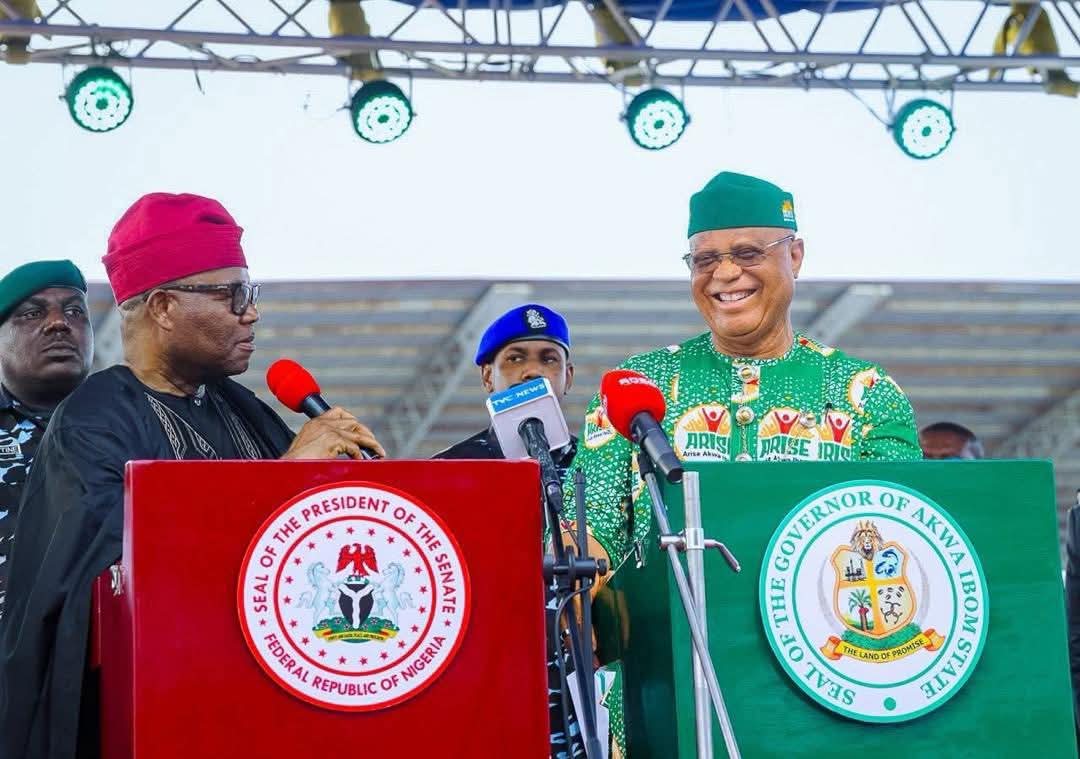
As Akwa Ibom State moves towards the 2027 general elections, Governor Umo Eno faces questions over the strength of his political base, his handling of political interests and his apparent reliance on Senate President Godswill Akpabio and the Ikot Ekpene Senatorial District for electoral support.
Governor Umo Eno, an Ibibio from Nsit Ubium Local Government Area in Uyo Senatorial District, would ordinarily be expected to draw substantial support from his home constituency and the wider Ibibio population across Uyo and Eket Senatorial Districts. However, concerns over his approach to governance, alleged failure to fulfil political promises, strained relationships with stakeholders and declining confidence among sections of his political base have raised questions about whether he can count on the level of support expected of an incumbent seeking re-election.
While Akpabio continues to rally political support within Ikot Ekpene Senatorial District, the Governor is facing questions about the unity of his own political structure.
The contrast raises a fundamental issue ahead of 2027: why should an incumbent governor depend heavily on a political bloc outside his immediate base when his own senatorial district and the wider Ibibio population would ordinarily be expected to constitute a substantial part of his electoral foundation?
Akpabio’s position as Senate President has given him considerable political influence and provided his supporters with a prominent figure around whom to unite. The growing cohesion within Ikot Ekpene Senatorial District is not necessarily based solely on the performance of its elected representatives; it is also connected to Akpabio’s position at the national level and the political opportunities his continued influence could offer the district.
The possibility of Akpabio retaining the Senate Presidency for another four-year term is viewed by his supporters as an opportunity to sustain the district’s influence in national politics. If achieved, another term would bring his tenure to eight years. The district’s calculations may also extend to political succession and the distribution of power in 2031, when its leaders and supporters could seek to preserve their influence within the state.
Against this background, the votes Governor Eno may be counting on from Ikot Ekpene cannot automatically be interpreted as a personal endorsement of his leadership. The district could instead use its voting strength as a bargaining instrument to pursue political appointments, power-sharing arrangements and future succession interests. If the Governor’s re-election strategy depends substantially on this support, he could find himself under pressure to accommodate Akpabio’s interests and the demands of the district after the election.
The political concern, therefore, is that Eno may be placing his re-election hopes on a bloc whose unity is driven primarily by its own political interests rather than by an unconditional commitment to his administration. This could leave the Governor negotiating from a weaker position if he has not rebuilt confidence among his own constituents before the election.
The concerns over Eno’s support base are particularly significant because his home constituency and the wider Ibibio population would ordinarily be expected to provide considerable electoral backing. His perceived failure to maintain confidence among political associates, limited engagement with sections of his political base, alleged unfulfilled promises, and approach to political relationships have become issues in the assessment of his prospects.
One of the claims raised in this political assessment is that, without electoral manipulation, Eno could receive more votes in Essien Udim, Akpabio’s local government area, than in his own Nsit Ubium Local Government Area. This is a political assertion that requires credible electoral evidence, but it reflects the concerns being expressed about the Governor’s relationship with his home constituency. The underlying argument is that Eno may be looking beyond his immediate base because he cannot be certain of securing a united bloc of votes from the people he would ordinarily expect to support him.
A major part of the criticism centres on the alleged influence of a political cabal that Eno entrusted with managing his political structure during the early years of his administration. The group is alleged to have exercised considerable influence over his political affairs, including his subsequent movement from the Peoples Democratic Party (PDP) to the All Progressives Congress (APC).
Rather than strengthening the Governor’s political base, the cabal is alleged to have influenced him to pursue decisions that served its members’ personal interests, contributing to resentment against his administration. After Eno joined the APC, members of the group allegedly pushed for the formation of ARISE WITH RENEWED HOPE, a political platform they subsequently hijacked and used to create problems across the state.
The Governor is also criticised for allegedly allowing the group to disregard zoning arrangements, particularly in Uyo and Eket Senatorial Districts, where Ibibios constitute a significant part of the population. The alleged consequences include strained political relationships, confusion over representation, and growing resentment among stakeholders who believe their interests have not received adequate consideration.
Eno’s alleged failure to maintain confidentiality in his dealings with political associates, coupled with what has been described as limited engagement with sections of his own political base, has further raised questions about trust. For a governor approaching an election, the ability to maintain confidence among stakeholders and fulfil political expectations is important to sustaining alliances. The criticism is that Eno’s handling of these relationships, alongside concerns over unfulfilled promises, has made it more difficult to consolidate support in his own constituency.
The cabal’s alleged activities have consequently become a potential liability for the administration. Instead of strengthening the Governor’s political position, the group is accused of creating more enemies for him than genuine supporters. The argument is that those entrusted with managing his political structure have allegedly used their influence to advance personal interests while leaving Eno to bear the consequences of unpopular decisions.
The Governor’s defection to the APC also raises questions about the benefits the state has derived from the move. The party has governed Nigeria at the federal level since 2015, first under former President Muhammadu Buhari and subsequently under President Bola Ahmed Tinubu. What tangible benefits has Akwa Ibom received from successive APC-led federal administrations, and what has Eno’s defection achieved for the state? What informed his decision to join the party, and has the change of political platform improved the state’s position at the federal level?
These questions are relevant as political actors assess whether party affiliation and proximity to powerful figures have translated into measurable benefits for residents. Political alignment should be judged not merely by membership of the ruling party but by the results it delivers to the state and its people.
Another concern is the alleged distribution of party positions and political appointments under the influence of the cabal. Influential members of the group are alleged to have secured appointments for their personal associates and domestic staff, including positions as chapter chairmen and members of party executive structures.
The criticism is that such positions could have been given to experienced politicians with established grassroots networks and the capacity to mobilise voters for the Governor. Chapter chairmen and party executives are expected to maintain relationships with members, canvass support and strengthen the party’s presence in their communities. Where strategic positions are allegedly given to individuals whose primary qualification is their relationship with powerful political actors, the administration risks losing opportunities to build a dependable grassroots structure.
The issue goes beyond who receives appointments to the question of loyalty. Some appointees are alleged to have been required to demonstrate allegiance to members of the cabal before receiving their positions, including through what has been described as oaths of loyalty. If established, this would raise concerns about whether individuals appointed to strengthen the Governor’s political machinery owe their primary allegiance to him and the party or to the individuals who secured their appointments.
The argument is that some of these appointees do not sufficiently associate with the wider political community or maintain the grassroots relationships expected of their positions. If so, their appointments may provide little benefit to Eno’s electoral ambitions. A political structure may appear extensive on paper but remain ineffective if those occupying strategic positions are not committed to building broad support for the administration.
The situation also presents an apparent contradiction in the conduct attributed to members of the cabal. They are said to portray Eno as a governor who controls everything in government and prevents others from functioning. Yet, when appointments are made in the party or government, the names of their associates and domestic staff allegedly feature prominently.
If Eno controls everything, why does he remain silent when members of the cabal allegedly submit the names of their preferred candidates for appointments? If the group claims that the Governor prevents its members from functioning, how are they able to secure strategic positions for their associates? Why are alleged oaths of allegiance required before appointments are granted if the Governor exercises effective control over the process?
The criticism is that members of the cabal allegedly secure appointments for their associates but distance themselves from unpopular decisions, leaving the Governor to bear the political consequences. When decisions affect the wider population, Eno is exposed to criticism, while those who may have influenced the decisions can avoid responsibility. The group’s alleged conduct has therefore been described as undermining, humiliating and sabotaging the Governor politically by creating more enemies for him than genuine supporters.
Eno, however, remains the chief executive of the state and the political figure ultimately responsible for the direction of his administration. His failure to challenge the alleged influence of the cabal raises questions about his control of the political machinery he is expected to lead. By the time he might have sought to regain control, members of the group had allegedly already placed their associates in strategic positions, potentially creating a structure whose loyalty rests more with the cabal than with the Governor.
The distribution of legislative tickets and the handling of zoning arrangements have added to the concerns surrounding Eno’s political decisions. The Governor has been criticised for supporting the return of lawmakers for third terms despite questions about their performance and objections over zoning. The argument is that legislative tickets have been handed to lawmakers considered underperforming by their critics, without sufficient regard for the interests of constituents or established political arrangements.
In Ikot Ekpene Senatorial District, Rt. Hon. Unyime Idem and Rt. Hon. Patrick Umoh, both members of the House of Representatives, are regarded by their supporters as among the better-performing representatives. Their names feature prominently in arguments about the district’s legislative representation and its ability to rally around lawmakers who enjoy the confidence of their constituents.
The Speaker of the Akwa Ibom State House of Assembly is also from Ikot Ekpene Senatorial District. However, the Governor’s reported support for a third term for the Speaker has also attracted criticism from those who question his performance. Prince Akpabio is described by his supporters as having performed well, while Samson Idiong is similarly regarded by his supporters as having delivered on his responsibilities.
By contrast, the performance of some lawmakers from Uyo and Eket Senatorial Districts has been questioned. The political argument further contends that no member of the House of Representatives from Uyo or Eket Senatorial Districts has performed at a level comparable to Idem and Umoh. Such comparisons require verifiable evidence, including legislative records, constituency projects and other measures of representation, but they form part of the criticism surrounding the distribution of legislative tickets and political representation across the state.
The central concern is that the Governor’s support for lawmakers whose performance has been questioned, particularly where the decisions are perceived to disregard zoning, could alienate constituents. If voters believe their interests have been ignored in favour of representatives they consider ineffective, their willingness to support the Governor may be affected.
Governor Umo Eno has weakened his own political position by backing third-term tickets for lawmakers considered underperforming by their critics while failing to give sufficient consideration to zoning and the demands of constituents. Rather than strengthening his political base, such decisions could deepen dissatisfaction in his own senatorial district and Eket Senatorial District, while the unity within Ikot Ekpene Senatorial District gives it greater leverage in negotiations ahead of 2027.
The perceived differences in political mobilisation and legislative performance could strengthen Ikot Ekpene Senatorial District’s bargaining position. Akpabio’s position as Senate President, the unity he has helped build within the district and the political interests surrounding his continued influence may provide the district with a stronger platform to negotiate over appointments, power-sharing and future succession.
That unity, however, should not automatically be interpreted as a guarantee of votes for Eno. The district’s leaders and constituents may be more concerned with protecting their interests, retaining influence at the federal level and positioning themselves for future political succession than with providing unconditional support for the Governor. This creates a potential imbalance in which Eno may need the district’s support more urgently than the district needs his candidacy.
The Governor’s relationship with Eket Senatorial District is also relevant to this political assessment. Eno has lived and built business interests in Eket, including the Royalty Hotel, making his relationship with the area another point of interest in assessing his political connections beyond his home local government. The question is whether these personal, business and political relationships have translated into sufficient confidence among constituents in Eket and Uyo Senatorial Districts.
The relationship between the resources available to the state government and public assessments of its performance is another issue ahead of the election. Eno has been described by his critics as a governor who has received the highest revenue in the history of Akwa Ibom State but whose performance has failed to match the opportunities presented by those resources. His approach to governance and the alleged influence of the cabal have also been blamed for growing dissatisfaction with his administration.
These assessments require supporting fiscal records, evidence of project delivery and reliable public-opinion data to establish conclusively. Nevertheless, the underlying question remains: how effectively has the administration translated available resources into results that residents can recognise and associate with the government? Revenue received, expenditure, completed projects, public services and the experiences of residents are relevant measures in assessing the relationship between government resources and performance.
The Guide Newspaper’s political assessment ahead of the 2027 elections raises questions about Eno’s leadership, his relationship with the Ibibio population, the alleged influence of the cabal and his reliance on Akpabio’s political structure. The central concern is that a governor who would ordinarily be expected to consolidate support in his home constituency and senatorial district is being portrayed as placing substantial hope in a political bloc outside that base.
The alleged appointment of domestic staff and personal associates to party positions, the claims of loyalty oaths, concerns over the marginalisation of experienced politicians, the handling of legislative tickets and the group’s alleged tendency to distance itself from unpopular decisions all raise questions about how political authority and responsibility are exercised within the administration.
For Eno, the challenge is whether he can rebuild trust among his own constituents, strengthen his political structure and demonstrate that his administration is guided by the interests of the wider population rather than those of a narrow circle of political associates. The 2027 election will test political alliances across Akwa Ibom State and the ability of different blocs to translate their interests into electoral support. It will also bring renewed attention to governance, public confidence, zoning, legislative representation and the distribution of political opportunities.
Ultimately, the questions surrounding the Governor’s political position concern leadership, trust, performance, consultation and political independence. If his re-election strategy depends heavily on Akpabio and Ikot Ekpene Senatorial District while his relationship with Uyo and Eket Senatorial Districts remains strained, the question will be why he has not consolidated the support base that would ordinarily be expected to underpin his bid for another term.
