

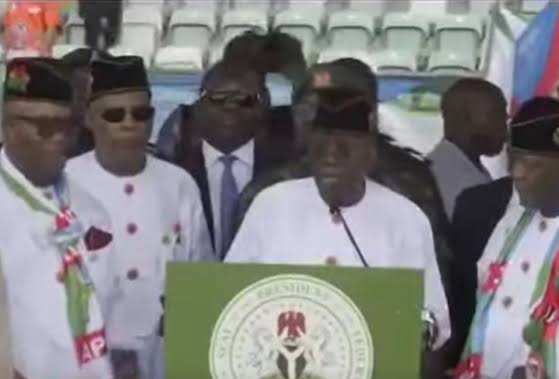
-As AKSG Lures President to Commission Airport Terminal Already Commissioned by Past Administration
-No new federal project commissioned or groundbreaking done in A’Ibom during visit
The much-anticipated visit of President Bola Tinubu to Akwa Ibom State was overshadowed by the tragic road clash leading to the death of one with others sustaining various degree of injuries.
The Guide Newspaper can authoritatively report that the presidential visit turned tragic along Oron Road in Uyo when an Akwa Ibom Transport Corporation (AKTC) bus carrying women to welcome the President collided with a security Hilux vehicle heading toward the airport. Emergency responders quickly rushed several injured passengers to nearby hospitals, while eyewitness reports indicated that at least one person lost their life in the crash.
Beyond the tragedy, public anger also flared across the state over comments made by President Tinubu during his official address, where he stated that he had approved the Ibom Deep Seaport.
Political groups, including the African Democratic Congress (ADC) and the Ibibio Vanguard, quickly condemned the statement as an empty promise. They noted that the Federal Executive Council under former President Muhammadu Buhari had already granted official statutory approval for the Ibom Deep Seaport project back in December 2020.
Critics also pointed out that while President Tinubu personally signed paperwork to secure direct federal funding for the Ogun State Seaport, he offered Akwa Ibom State only verbal promises without concrete budgetary allocations or financial guarantees.
Community leaders and opposition members maintain that the people of Akwa Ibom State deserve real development, funding commitments, and equal treatment rather than recycled political speeches.
Another major talking point was the commissioning of the Akwa Ibom International Airport terminal, a project that had previously been commissioned under former Governor Udom Emmanuel. Tinubu’s commissioning of the same facility has therefore raised questions about the repeated presentation of an already inaugurated project as a major achievement.
For residents who expected the presidential visit to bring fresh federal commitments backed by visible action, the event also raised questions about why no new federal project was commissioned and why no foundation stone was laid for a major federal infrastructure project in the state.
The concern is particularly significant given the expectations surrounding the visit and the importance attached to the relationship between the Federal Government and Akwa Ibom. Beyond political speeches and public declarations, residents would naturally want to know what specific federal projects were secured for the state and when they would be delivered.
Yet, beyond the infrastructure questions, another issue arising from the President’s interaction with Oku Ibom Ibibio, the revered traditional institution, deserves serious attention.
During the interaction, Tinubu reportedly remarked that he had listened to Oku Ibom Ibibio and that the traditional ruler spoke better, describing his speech as “Akwa Ibom English.” While the President may have intended the remark as a compliment to the traditional ruler, it raises a question about the comparison being made.
If the President found the traditional ruler’s speech easier to understand, does that mean Senate President Godswill Akpabio, who had also spoken during the engagement, did not communicate as clearly? Was the President suggesting that Akpabio’s way of speaking was less understandable than that of Oku Ibom Ibibio?
What exactly is Akwa Ibom English? Is there a universally accepted English accent that every Akwa Ibomite must speak before being considered articulate? Does Senate President Godswill Akpabio speak exactly the same way as the traditional ruler? Do all educated and accomplished Akwa Ibom people communicate with identical accents?
The point is not to question the President’s right to express a preference or compliment the traditional ruler. Rather, it is to examine the implication of the comparison and whether it creates an unnecessary standard for how Akwa Ibom people should speak English.
English is a common language of communication, not the exclusive cultural property of any ethnic group. Across Nigeria, people speak English with accents shaped by their mother tongues, cultural environments and educational experiences. This is not peculiar to Akwa Ibom.
Having an accent is not a deficiency. Speaking English differently does not make anyone less intelligent, educated, articulate or sophisticated. The ability to communicate should not be judged by whether a person’s accent conforms to another person’s expectations.
The concern, therefore, is not about whether the President intended to ridicule anyone. It is about the interpretation and implications of his remark, particularly when made by the nation’s leader during an engagement with a revered traditional institution. The office of the President carries enormous influence, and words spoken from that position deserve careful consideration.
Equally troubling is the political declaration that Akwa Ibom would deliver two million votes to President Tinubu in 2027. With all due respect to Senate President Godswill Akpabio and other political leaders making such projections, electoral promises must be measured against political realities. Elections are not won through declarations, public confidence or political pronouncements alone. They are determined by the collective decisions of voters.
There is a reason to be cautious about sweeping electoral predictions. Nigerians will recall the famous declaration that an election would be over in less than three minutes. Events eventually unfolded differently from that prediction. This is not an attempt to ridicule or attack Senator Akpabio, for whom I have respect, but a reminder that political projections should never be confused with actual electoral outcomes.
More importantly, remarks that appear to diminish the linguistic or cultural identity of Akwa Ibom people should concern everyone, including Governor Umo Eno, irrespective of political affiliation. The responsibility to protect the dignity of the people cannot be surrendered for political convenience or party loyalty.
This is not about APC versus PDP. It is not about President Tinubu versus Akwa Ibom. It is about mutual respect, cultural identity and the dignity of our people.
If Nigerians from other ethnic backgrounds can speak English with accents influenced by their indigenous languages without being treated as inferior, why should Akwa Ibom people be made to feel differently? No ethnic group should have to defend its accent or cultural expression to earn respect.
President Tinubu is Nigeria’s President, and the office he occupies deserves respect. But respect for leadership must be reciprocal. It must also accommodate the dignity, culture and identity of the people being led. Respect for the President does not require Akwa Ibom people to remain silent when they feel their identity has been diminished.
Ultimately, the question Akwa Ibom people must ask is straightforward: beyond the political gathering, speeches, promises and repeated commissioning, what concrete benefits has the state secured from the presidential visit?
A presidential visit should provide an opportunity to advance projects, attract investment and strengthen federal commitments to the host state. For Akwa Ibom, the public will be looking for evidence that the visit translated into tangible development rather than another occasion dominated by political assurances.
The Ibom Deep Seaport must move beyond announcements to verifiable progress. Federal commitments must be measurable, and the dignity of Akwa Ibom people must remain non-negotiable. The people deserve development, accountability and respect, not merely political promises.
