

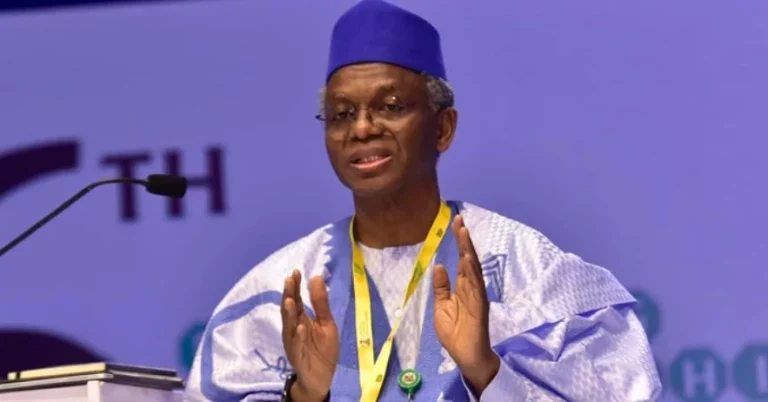
The Federal High Court in Abuja has ruled that former Kaduna State Governor Nasir El-Rufai must answer allegations of unlawful telephone interception, dismissing his application to end the trial without presenting a defence.
Justice Joyce Abdulmalik, in a ruling on Monday, held that the prosecution had presented sufficient evidence to require El-Rufai to respond to the allegations contained in the five-count amended charge brought against him by the Department of State Services (DSS).
The judge consequently directed the former governor to open his defence and adjourned the case until November 25, 2026.
El-Rufai had filed a no-case submission after the Federal Government concluded its presentation of evidence, asking the court to discharge and acquit him on the grounds that the prosecution had not established a case requiring him to defend himself.
Through his counsel, Paul Erokoro, SAN, the former governor argued that the evidence presented during the trial was insufficient to justify calling on him to enter a defence.
The prosecution, however, urged the court to reject the application. Its counsel, Oluwole Aladedoye, SAN, maintained that the oral and documentary evidence before the court established a prima facie case against the defendant.
Aladedoye also argued that the defence had failed to adequately address Exhibit B, which the prosecution described as containing an admission relating to the alleged interception of telephone communications involving National Security Adviser Nuhu Ribadu.
In dismissing the no-case submission, Justice Abdulmalik held that the evidence presented by the prosecution was sufficient to require El-Rufai to respond to the allegations.
The ruling does not determine the former governor’s guilt but allows the trial to proceed to the defence stage.
The case followed comments El-Rufai made during an interview on Arise Television’s Prime Time programme in February 2026, when he alleged that someone had intercepted a telephone conversation involving Ribadu and passed it to him.
During the interview, El-Rufai claimed that the conversation indicated that Ribadu had directed security operatives to arrest him at the Nnamdi Azikiwe International Airport in Abuja after his return from Cairo, Egypt.
The DSS subsequently instituted proceedings against him over alleged unlawful interception of communications and related offences under the Cybercrimes (Prohibition, Prevention, etc.) Amendment Act, 2024, and the Nigerian Communications Act, 2003.
The prosecution called two witnesses before closing its case. El-Rufai has pleaded not guilty to the charges.
With the court’s rejection of his application, proceedings are expected to resume on November 25, when he is scheduled to begin presenting his defence.
