

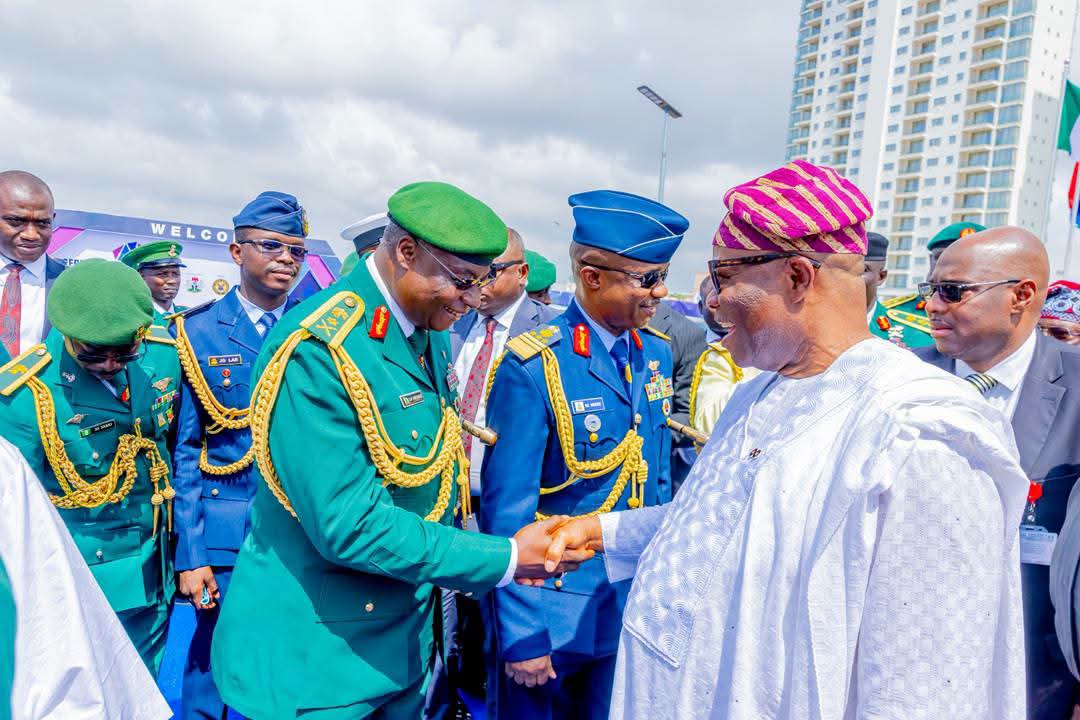
President Bola Ahmed Tinubu has urged African countries to strengthen defence partnerships to ensure that military cooperation delivers lasting benefits through skills development, technology transfer, local industrial growth and improved security capabilities.
Tinubu made the call in his remarks at the opening ceremony of the Africa International Defence Exhibition (AFRIDEX) 2026 in Lagos. He was represented at the event by the President of the Senate, Godswill Akpabio.
The President said defence partnerships must deliver value long after military equipment has been supplied, stressing that every major acquisition should contribute to developing local expertise, strengthening indigenous industries and improving countries’ capacity to maintain the equipment they operate.
“Every major acquisition should help develop skills, transfer knowledge, strengthen local industry and deepen our capacity to maintain what we operate,” Tinubu said.
He noted that the success of defence partnerships should be measured by the capabilities they leave behind, adding that African engineers must acquire expertise, local enterprises must grow, and institutions must become stronger.
Tinubu also called for sustained support for African-led peace operations, stressing that the commitment to respond to crises must be matched with predictable funding, adequate equipment, rigorous training and institutional support.
“Those we send to keep the peace must have the means to keep the peace,” he said.
The President described AFRIDEX as an opportunity to bring together military experience, innovation and industry to develop practical solutions that strengthen Africa’s defence capabilities.
He said security threats across the continent, from the Gulf of Guinea to the Sahel and from territorial borders to cyberspace and outer space, were becoming increasingly complex and interconnected.
According to him, the threats endanger lives and livelihoods, disrupt trade and undermine development, making collective action essential to achieving lasting peace and prosperity.
“Nigeria speaks from experience. We know the cost of insecurity: the lives lost, the communities displaced, the livelihoods interrupted and the opportunities denied,” Tinubu said.
He acknowledged the sacrifices of the Nigerian Armed Forces in confronting terrorism, insurgency, banditry, piracy and other transnational threats, paying tribute to personnel who had lost their lives in the line of duty.
He said their sacrifices placed an obligation on government to provide the leadership, equipment, training and support required to strengthen military operations.
Tinubu added that lasting security depended not only on military strength but also on strong institutions, public trust, reliable partnerships and the industrial capacity to sustain defence operations.
On maritime security, the President urged African countries to deepen cooperation to protect the Gulf of Guinea, describing the region as critical to trade, energy security and shared prosperity.
He said stronger maritime cooperation would help legitimate commerce thrive while denying criminal networks safe havens.
The President also called on African countries to prepare for the changing nature of conflict, noting that cyber capabilities, space technologies, artificial intelligence and autonomous systems were transforming the security environment.
He urged the continent to invest in the knowledge and institutions needed to understand and responsibly deploy emerging technologies while developing home-grown solutions.
“Our young people have the talent; our responsibility is to create the opportunity,” he said.
Tinubu described AFRIDEX 2026 as a renewed commitment to converting Africa’s potential into practical defence capabilities, urging participants to ensure that partnerships, knowledge-sharing and commitments made at the exhibition translated into measurable results.
He said the ultimate goal was to build African nations where peace creates opportunities, public service earns trust and citizens could approach the future with confidence.
The statement was signed by Jackson Udom, Special Assistant to the President of the Senate on Media.
