

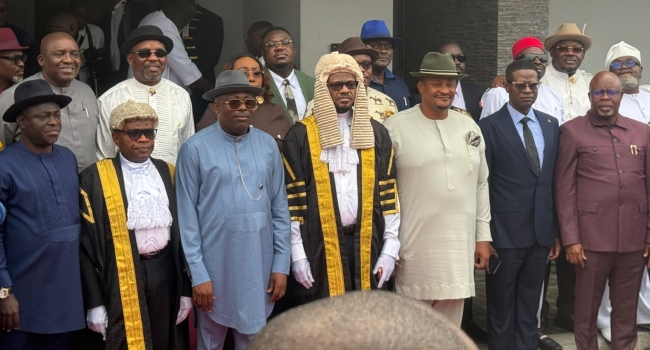
Rivers State Governor, Siminalayi Fubara, has presented a proposed ₦1.854 trillion Appropriation Bill for the 2026 fiscal year to the Rivers State House of Assembly, marking his first appearance before the Assembly led by Speaker Martin Amaewhule since the political crisis that divided the legislature in 2023.
The budget presentation, which signals a major shift in the state’s political landscape following the reconciliation between the governor and lawmakers after nearly three years of parallel legislative sittings, was conducted during plenary at the Assembly complex.
Proceedings began with Speaker Amaewhule entering the chamber in full ceremonial regalia ahead of the governor’s arrival. A motion to receive Governor Fubara was moved by Majority Leader Major Jack and seconded by Minority Leader Sylvanus Nwankwo before the governor formally presented the appropriation bill.
Tagged “Budget of Resilience for Growth and Development,” the proposed budget is designed to drive economic growth, expand infrastructure, strengthen human capital development and increase social investments across Rivers State.
Governor Fubara projected total revenue of ₦1.854 trillion for 2026, representing a 24.49 per cent increase over the adjusted 2025 budget. He attributed the projected growth to expected increases in allocations from the Federation Account Allocation Committee (FAAC), higher derivation revenue and improved internally generated revenue (IGR).
Of the total budget, ₦413.1 billion has been allocated for recurrent expenditure, while ₦1.405 trillion is earmarked for capital projects.
The capital expenditure includes ₦533.3 billion for works and infrastructure, ₦315 billion for education, ₦105.4 billion for healthcare, ₦41.4 billion for the Rivers State House of Assembly, ₦30 billion for the judiciary and ₦19.3 billion for agriculture, alongside allocations to other critical sectors.
The governor also announced plans to increase overhead allocations to Ministries, Departments and Agencies (MDAs) by at least 50 per cent, while pledging to clear outstanding gratuities and death benefits owed to retired civil servants.
Fubara stated that his administration has maintained fiscal discipline through prudent management of public finances, reaffirming its commitment to accountability, transparency and responsible spending.
He assured residents that every public fund would be judiciously utilised to create employment opportunities and improve the welfare of the people.
“We will ensure every kobo is spent wisely to create jobs for our people. The collective interests of our people are most important to us as a government,” the governor said.
He appealed to lawmakers to give speedy approval to the budget, describing it as a people-focused roadmap for accelerating development, attracting investment, creating jobs and improving the standard of living across Rivers State.
“Let us join hands to make sure Rivers State continues to stand out in good governance,” he added before formally presenting the budget to Speaker Amaewhule.
Receiving the appropriation bill, Speaker Amaewhule assured the governor that the House would give the proposal thorough consideration.
“Let me assure you on behalf of the members that we will give due consideration to your budget proposals,” he said.
The Speaker stressed that lawmakers remained committed to fulfilling their constitutional responsibilities and working collectively to advance the state’s development.
“Our state has to grow, and all hands have to be on deck for the growth of Rivers State. We are willing to do all that is needed as an Assembly so our people can smile again,” Amaewhule stated.
The 2026 Appropriation Bill subsequently passed its first reading during the plenary.
Following the proceedings, Governor Fubara exchanged warm pleasantries with members of the Assembly before he was escorted out of the chamber by Speaker Amaewhule and other lawmakers for a group photograph, symbolising renewed cooperation between the executive and legislative arms of government after years of political tension.
The House later adjourned plenary until July 20, marking another step in what observers see as a new era of executive-legislative harmony in Rivers State.
