

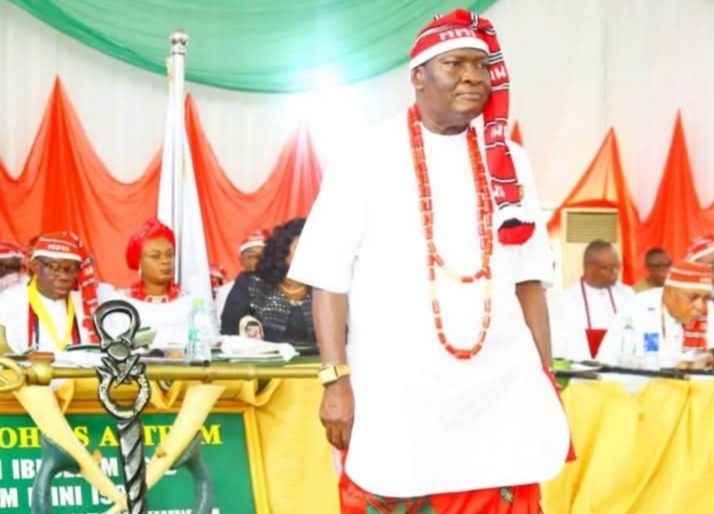
Mboho Mkparawa Ibibio (MMI), the foremost socio-cultural organisation of the Ibibio ethnic nationality, has declared its support for Ekid People’s Union (EPU), following the public backlash over the statement by the President-General of EPU, Dr. Samuel Udonsak, during the inauguration of the 12th International Executive Council of Mboho Mkparawa Ibibio on Friday, 24th July, 2026.
The organisation, which stated its position in a communiqué jointly signed by its International President, Akparawa Ini-Abasi Ekanem, and International Secretary-General, Akparawa John Offiong, affirmed that all statements made during the inauguration ceremony of the 12th International Executive Council were founded on verifiable historical facts, established legal principles, and constitutional realities, adding that the statements represented the official and considered position of the organisation and not the personal opinions of any individual.
“MMI expresses concern over persistent attempts to reference Ekid, Itu Mbonuso, Nkari, and other Ibibio sub-groups as distinct ethnic nationalities rather than by their proper historical and collective identity as components of the Ibibio ethnic nationality.
“The organisation observes that, over several decades, some political actors within the Oron Federal Constituency have pursued what scholars describe as ethnic balkanisation by nomenclature with the apparent objective of weakening the political and developmental cohesion of the Ibibio people.
“MMI reiterates that the Oron Federal Constituency is historically and anthropologically composed of both Ibibio and Efik elements, while the core Oro ethnic group traditionally occupies parts of Oron and Urue Offong/Oruko Local Government Areas. The Ibibio ethnic nationality has never sought to fragment the Oro people for political advantage and therefore rejects every attempt to portray Ibibio unity as a threat while simultaneously promoting ethnic fragmentation.
“MMI observes that since the withdrawal of a section of the Oro people from the Ibibio ethnic group in 1937 following the Ibibio State Union scholarship initiative, a recurring pattern has emerged whereby certain Oro leaders and commentators resort to ethnic blackmail whenever legitimate historical or legal issues are raised.
“The organisation notes with concern the increasing incidence of disparaging comments directed at the Ibibio people and several of their distinguished leaders across social media and other public platforms. Such conduct is inconsistent with genuine calls for peace, restraint, and responsible leadership.
“MMI particularly states that former Governor Udom Emmanuel, CON, inherited the Ibom Deep Seaport project from previous administrations and neither commissioned nor authored the technical reports relating to the project.
“Consequently, Mboho Mkparawa Ibibio hereby gives notice that it will no longer tolerate defamatory or disparaging remarks directed against any Ibibio leader, son, or daughter. Such actions shall be challenged through every lawful means available.
“MMI recalls that on 25th June, 1999, stakeholders from the Oron Federal Constituency adopted the Oro Bill of Rights, which proposed political alignment with Ibeno and Eastern Obolo in pursuit of state creation.
“The organisation notes that Section 8(1) of the Constitution of the Federal Republic of Nigeria, 1999 (as amended), prescribes constitutional requirements for state creation, including territorial contiguity. MMI observes that the Oron Federal Constituency, Ibeno Local Government Area, and Eastern Obolo Local Government Area do not constitute one continuous landmass”, it noted.
The Pan-Ibibio Organisation further observed that the various clans within the Oron Federal Constituency do not share a common ethnic origin with the peoples of Ibeno and Eastern Obolo, adding that it therefore regards the Oro–Obolo alliance as principally a political arrangement aimed at advancing the objectives contained in the Oro Bill of Rights.
“MMI condemns the circulation of unofficial maps purporting to annex portions of the Ibibio coastline to the Oron Federal Constituency.
“The organisation reaffirms that the Akwa Ibom State Map Establishment Law, 2023, remains the extant legal instrument defining the territorial boundaries of Akwa Ibom State and its Local Government Areas. The law neither excises any Ibibio territory nor transfers any Ibibio coastal land to the Oron Federal Constituency.
“MMI maintains that any grievances regarding the official map should be pursued before courts of competent jurisdiction rather than through propaganda or historical revisionism.
“MMI acknowledges that agitation for state creation is a legitimate constitutional right within a democratic society. However, the organisation insists that any future state must be created strictly from lawfully constituted territory.
“Drawing from historical precedent, MMI notes that neither the creation of the South-Eastern State in 1967 nor the creation of Akwa Ibom State in 1987 involved the annexation of another ethnic group’s territory.
“Accordingly, MMI declares that no portion of Ibibio ancestral land shall be ceded, annexed, or alienated under the guise of state creation, and that this position shall continue to be defended through lawful constitutional means.
“MMI welcomes calls for judicial determination of contentious issues and fully supports the resolution of disputes through the courts rather than through media campaigns.
“The organisation believes that questions relating to the legal definition of littoral communities, offshore oil production, territorial boundaries, host community status, and jurisdiction over the Ibom Deep Seaport are matters appropriately reserved for judicial determination.
“MMI recognises the Ibom Deep Seaport as a strategic economic project of immense importance to Akwa Ibom State and Nigeria.
“The organisation maintains that issues relating to its location, host communities, territorial jurisdiction, and benefit-sharing must be resolved strictly through law, technical evidence, environmental impact assessment, and due process rather than competing ethnic narratives.
“MMI reiterates its commitment to peace, dialogue, constitutionalism, and responsible public discourse.
While condemning inflammatory language and the politicisation of women or any other group in ethnic disputes, the organisation maintained that leadership demands accountability and those who advocate restraint must themselves demonstrate restraint in both words and conduct.
“All ethnic organisations, leaders, and stakeholders to pursue disagreements through constitutional and judicial processes rather than inflammatory public campaigns.
“The Government of Akwa Ibom State, under the leadership of His Excellency, Akparawa (Pastor) Umo Eno, Ph.D., to continue upholding the rule of law and ensuring that no individual or group undermines peace through propaganda or deliberate distortion of history.
“Ibibio youths to remain peaceful, law-abiding, intellectually engaged, and steadfast in defending the heritage and legitimate interests of the Ibibio people through lawful and constitutional means.”
The organisation reaffirmed its unwavering commitment to peaceful coexistence, justice, constitutionalism, and the preservation of the historical identity and territorial integrity of the Ibibio ethnic nationality, calling on all stakeholders to allow historians to examine history, lawyers to interpret the law, the courts to determine legal disputes, and every ethnic nationality in Akwa Ibom State to embrace peace founded on truth, justice, and the rule of law.
