

By Udo Silas
“I URGE ALL OF US HERE TO GO GET OUR VOTERS ‘ CARDS READY. LET’S SHOW THE INFIDELS THEIR LIMIT, WHO CLAIM THEY ARE MORE THAN US IN NIGERIA. THEY ARE LYING”…Sheikh Yahya Jingir
I never believed a time would come when I will see the muslim-muslim ticket, in the configuration of our presidential elections candidacy, as anything more than what it is; a political decision at the mercy of the electorate.
But the quote above, from Sheikh Yahya Jingir, certainly stirred some fearful thoughts.
To be fair, Nigeria did not stumble into the Muslim–Muslim ticket by accident; it first arrived wrapped in the mystique of June 12, 1993, when Moshood Kashimawo Abiola and Babagana Kingibe—both Muslims—rode a rare national consensus to what many still call Nigeria’s fairest election.
Abiola’s candidacy cut across regions and faiths, buoyed by his philanthropy, his bridge-building persona, and a military-decreed two‑party structure that narrowed choices and softened sectarian reflexes.
Nigerians, exhausted by military rule, momentarily suspended old fears to embrace a man who seemed larger than his mosque, larger than his ethnicity, and, for once, larger than the generals.
Three decades later, Bola Tinubu’s Muslim–Muslim ticket did not descend as a symbol of unity, but as a cold calculation of vote banks and religious consolidation.
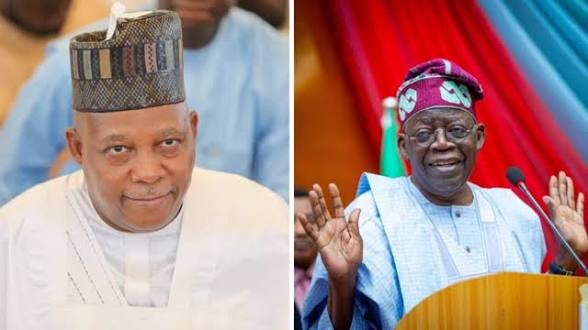
Where Abiola’s campaign felt like a broad national embrace, Tinubu’s pairing with Kashim Shettima rode on the explicit logic of locking down northern Muslim votes against rival Muslim contenders, provoking open opposition from Christian bodies and Middle Belt groups who saw it as an exclusionary project.
The legitimacy of Tinubu’s victory remains heavily disputed in court of public opinion, unlike the near-unanimous memory of Abiola’s annulled mandate, which many Nigerians still regard as stolen, not contested.
Enter Sheikh Yahya Jingir, urging worshippers to brand fellow citizens “infidels” and to “show them their limit” at the ballot box, while hailing Tinubu as the hero of a “purely Muslim-Muslim coalition.”
His words are not mere fanatic noise; they are a political doctrine of supremacy, drawing electoral maps with a cleric’s finger dipped in acid, not ink.
Under Abiola, a Muslim–Muslim ticket was an exception wrapped in an inclusive spirit; under Tinubu, amplified by clerics like Jingir, it risks becoming a creed that normalises the idea that Nigeria “belongs” more to one faith than another.
A nation already fraying under ethnic resentments and economic despair cannot afford a ballot paper that doubles as a religious test.
To continue to allow same‑faith presidential tickets is to play draft with dry tinder in a room already warm with mutual suspicion.
If politics insists on exploiting religion, then the constitution must step in—not as a sermon, but as a firewall—by requiring faith balancing on presidential tickets, or, more radically, by banning same‑faith pairings outright.
Days after this cleric spoke, Tinubu nor any of the governors present when he made this comment, has not reprimanded him.
Is it possible that Tinubu, like the Sheikh, sees Christians and people of other faiths as infidels?
Is this what Tinubu’s Nigeria has been reduced to?
To be candid, ending the Muslim–Muslim ticket is not an attack on Islam; it is a plea for Nigeria—this fragile, noisy experiment—to choose coexistence over conquest, inclusion over arithmetic, and citizenship over congregation.
Tinubu has made us hungry, strained, stressed, weary and mourners.
Now his clerics tell us the plain truth we never want to believe.
That we are INFIDELS.
We remain infidels, all, until we stop the muslim-muslim ticket.
Through the ballot.
Or through constitutional amendment.
Or else….we bleed slowly to extinction.
