

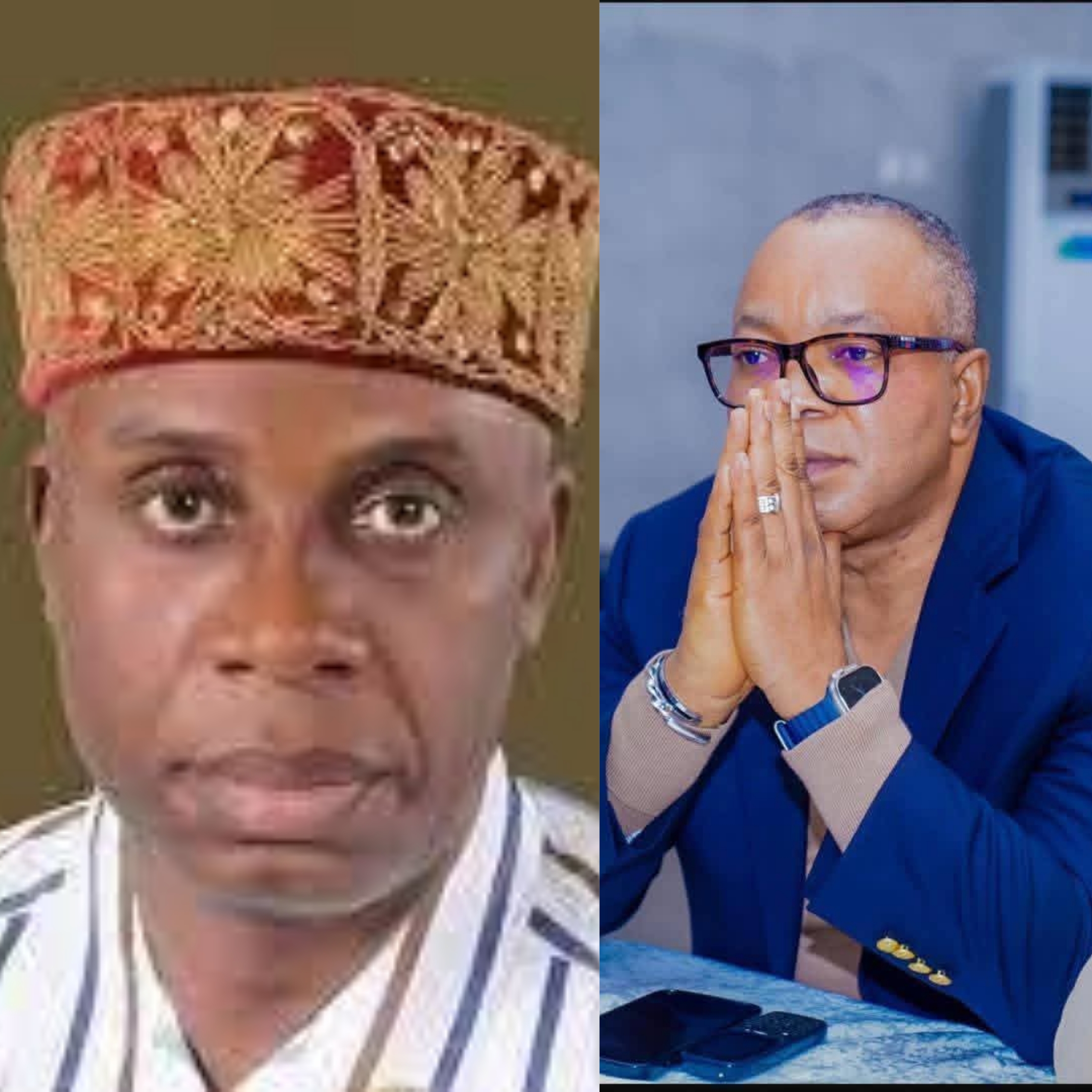
By Udo Silas
Rotimi Amaechi heard the growl beneath Nigeriaʼs silence and called it by its true name:
hunger.
Jarret Tenebe answered with the grammar of the gun.
Between the former ministerʼs warning that there may be no Nigeria if the 2027 election is rigged, and the Edo APC chairmanʼs invocation of “AK-47 fire” against those who obstruct a proposed 2.5 million votes for President Bola Tinubu, lies the frightening portrait of a republic standing before a mirror with a match in its hand.
Amaechi says Tinubu represents the choice of death.
Tenebe appears to say that resistance to Tinubuʼs victory may be answered with death.
One speaks of the graveyard produced by economic despair; the other, even if couched as political theatrics, summons the imagery of a rifle over the ballot box.
That is not democracyʼs language.
Democracy is the solemn agreement that the citizenʼs thumb, stained by ink, is stronger than the politicianʼs fist.
Free and fair elections mean citizens may organise, speak, campaign, vote secretly, have every lawful vote counted, and challenge an outcome without being hunted as enemies of the state.
Nigeriaʼs anguish supplies the tinder.
Headline inflation stood at 15.39 percent in August, but food inflation was 19.57 percent year-on-year—the kind of statistical moderation that means little to the mother pricing rice with a trembling purse.
Petrol has reportedly sold around ₦1,350–₦1,430 per litre in major markets; cooking gas has climbed to roughly ₦1,500–₦1,600 per kilogramme.
Transport fares, rent, medicine, school fees and the ordinary ceremony of eating have become negotiations with humiliation.
A people may survive hardship; what they rarely forgive is hardship accompanied by mockery.
Consider the sick Nigerian, already standing at the gate of a hospital where nearly 71 percent of health expenditure comes directly from private pockets, often without insurance.
Consider the farmer chased from the field by violence, the trader whose profits evaporate in fuel costs, and the household where hunger has become an unwanted tenant.
The World Food Programme estimate cited by the BBC says 35 million Nigerians may face food insecurity in 2026, up from 24.8 million in 2023.
This is not merely economics.
It is political weather: pressure gathering beneath a national roof.
And pressure becomes perilous when dissent is treated as contraband.
Police cancelled an Obidient Movement march in Akwa Ibom after approvals had reportedly been issued, citing security concerns.
In Maiduguri, five men associated with “Tinubu Must Go” T-shirts were arrested and arraigned; police insist the case involved allegations beyond the shirts, including disturbance, thuggery and suspected drug possession, while political opponents contest that account.
The point is not to prejudge guilt.
It is to recognise the poisonous symbolism: when peaceful political expression looks endangered while men in authority casually advertise the AK-47, citizens begin to suspect that power has assigned different rules to the powerful and the powerless.
Thomas Hobbes warned that fear is the raw material of political order; yet a state that governs mainly through fear eventually manufactures the disorder it claims to prevent.
Frantz Fanon understood that humiliation can turn silence into fury.
Hannah Arendt warned that power is not violence: power rests on consent, while violence appears where power is failing.
A party confident of popular love does not need to speak as though votes are hostages to be delivered at gunpoint.
Nor should political figures—whether Tenebe, Wike, or the many merchants of macho rhetoric—mistake loudness for legitimacy.
The people are not political furniture.
Africa has seen the danger before.
In Burkina Faso, mass resistance in 2014 helped defeat Blaise Compaoréʼs attempt to prolong his rule; in Senegal, popular mobilisation and judicial intervention pushed back against attempts to delay the 2024 election.
Across the continent, high living costs have repeatedly provided the spark for wider anger where people already believe institutions have closed their doors.
Nigeria need not copy any country’s tragedy.
Revolution is not romance; it is what occurs when lawful exits are blocked and despair begins to think it has no constitutional language .
There are sufficient grounds for grave alarm, not for a wish for chaos.
If elections are transparently conducted, campaigns protected, security agencies impartial, votes honestly counted and courts credibly available, anger can pass through the ballot box and return as democratic correction.
But if hunger is met with arrogance, lawful protest with repression, opposition with intimidation, and ballots with the shadow of force, the state will be rehearsing its own undoing.
Politicians should therefore lower their guns—the literal ones and the rhetorical ones.
The police must protect every lawful campaign, not become the gatekeeper of approved opinions.
INEC, the courts and all institutions of state must remember that their first loyalty is not to the party that appoints or flatters them, but to the citizen whose faith keeps the republic alive.
A nation cannot be permanently governed by threats.
One day, the frightened discover that they are many; and when fear changes address, every palace learns how thin its walls have always been.
