

By Iniubong Sam
Stakeholders from Nigeria’s oil-producing communities, government agencies, regulatory bodies and civil society organisations have renewed calls for accountability, environmental justice and sustainable development in the Niger Delta.
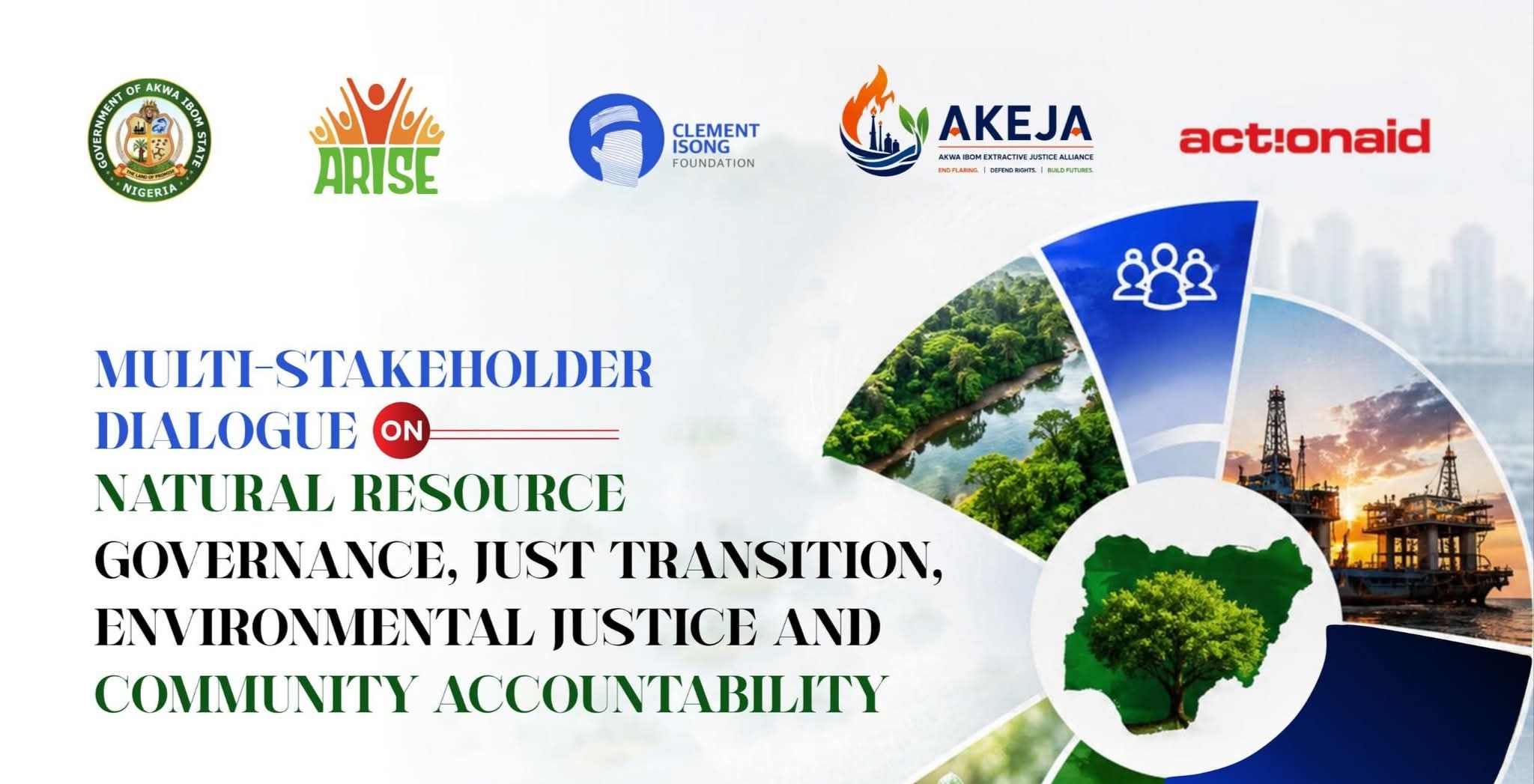
The call was made during the Multi-Stakeholder Dialogue on Natural Resource Governance, Just Transition, Environmental Justice and Community Accountability, convened by the Akwa Ibom Extractive Justice Alliance (AKEJA) in partnership with ActionAid Nigeria and the Clement Isong Foundation (CIF) under the Strategic Partnership Agreement II (SPA II) Programme, with support from the Danish International Development Agency (DANIDA).
The dialogue, held at D’Angelo Hotel, Uyo, with the theme “Advancing Community-Centred Natural Resource Governance and a Just Transition for Extractive Communities,” brought together government institutions, regulatory agencies, civil society organisations, development partners, traditional institutions, host communities, women groups, youth organisations and other stakeholders to discuss pathways towards a more transparent, inclusive and sustainable extractive sector.
The engagement sought to expand the conversation around a central question: What has decades of extractive activity done to the livelihoods, environment and economic future of our communities?
Participants examined the implementation of the Petroleum Industry Act (PIA) 2021, five years after its enactment, assessing what it has delivered to host communities, areas where implementation has fallen short and stakeholders responsible for addressing identified gaps.
The dialogue also confronted the persistent realities of oil spills, gas flaring and the degradation of farmlands and waterways across the Niger Delta.
A major highlight of the engagement was the diversity of participants around the table. The dialogue was not merely civil society speaking to itself, as representatives from the Akwa Ibom State Ministry of Environment and Mineral Resources, Nigerian Upstream Petroleum Regulatory Commission (NUPRC), National Oil Spill Detection and Response Agency (NOSDRA), Niger Delta Development Commission (NDDC), traditional institutions, women groups, youth organisations and community leaders participated actively.
Some participants travelled from communities where gas flares burn close enough to illuminate the night, bringing firsthand accounts of the environmental and economic challenges faced by extractive communities.
One of the major discussions centred on the implementation of provisions of the Petroleum Industry Act relating to gas flare penalties and environmental remediation.
Section 104(4) of the Petroleum Industry Act 2021 provides that revenues from gas flare penalties are to be used for the environmental remediation and relief of the host communities where those penalties arise.
Stakeholders noted that the intention of the law is clear: communities that bear the environmental burden should also receive the remediation.
The dialogue further examined Section 52(7)(d), which designates the Midstream and Downstream Gas Infrastructure Fund as the channel for collecting those penalties, while Section 103 separately requires licensees to contribute to an environmental remediation fund.
Participants noted that although these are different provisions, they are guided by the same principle that the polluter should bear the cost of pollution.
However, concerns were raised that between 2021 and 2024, roughly ₦700 billion in gas flare penalties was reportedly received, while communities including Ibeno, Esit Eket and Eastern Obolo continue to ask a legitimate question: where is the remediation?
The concern deepened following Executive Order 9 (February 2026), which stakeholders said redirected gas flare penalty remittances into the Federation Account for general distribution.
Participants observed that while the Order changes where the money goes, it does not amend Section 104(4) of the PIA, which still prescribes its statutory purpose. They noted that the development raises important legal and constitutional questions requiring careful public scrutiny.
Delivering the keynote address, Dr Fyneface Dumnamene Fyneface, Executive Director of Youths and Environmental Advocacy Centre (YEAC-Nigeria), said natural resource governance must focus on people, justice, accountability and equitable benefits for host communities. He stressed that extraction without accountability is exploitation, noting that while the PIA 2021 established Host Community Development Trusts (HCDTs) through the three per cent Host Community Fund, implementation challenges including poor transparency, weak community participation and exclusion of women and youths remain concerns.
Dr Fyneface called for a community-centred just transition that prioritises environmental remediation, renewable energy, green skills and meaningful participation of host communities. He advocated institutionalising Free, Prior and Informed Consent (FPIC), ensuring at least 30 per cent representation for women and young people in HCDT governance structures, publicly disclosing HCDT budgets, conducting independent community audits and strengthening community-led environmental monitoring.
The dialogue recorded several measurable outcomes, including the participation of more than 50 stakeholders, with approximately 60 per cent representation from host communities and women-led groups.
Stakeholders documented commitments to strengthen HCDT implementation under the PIA, improve transparency in revenue utilisation, fast-track environmental remediation, scale community renewable energy initiatives and deepen civic participation.
Regulatory agencies including NOSDRA and NUPRC engaged directly with civil society organisations, media representatives and community stakeholders to strengthen compliance monitoring and grievance redress mechanisms.
An Akwa Ibom State Action Plan was adopted and initiated to track HCDT fund utilisation and environmental remediation timelines in host communities over the next 12 months, while community monitors were nominated for training on PIA provisions and environmental reporting.
The dialogue concluded with the adoption of the AKWA IBOM DECLARATION, which calls for:
1. Institutionalising Free, Prior and Informed Consent (FPIC);
2. At least 30 per cent representation for women and young people in HCDT governance structures;
3. Transparent budgets and independent community audits; and
4. Greater investment in renewable energy, green skills, agroecology and mangrove restoration instead of symbolic projects.
The Declaration also calls for gas flare penalties to be restored to the purpose envisaged under Section 104(4) of the Petroleum Industry Act.
Stakeholders reaffirmed that a just transition must place people first, stressing that governance, accountability and environmental justice cannot be treated as afterthoughts.
The organisers, the Akwa Ibom Extractive Justice Alliance (AKEJA), Clement Isong Foundation (CIF) and ActionAid Nigeria, received commendations for convening the dialogue and providing a platform for critical conversations on accountability, community participation and environmental justice. Participants and stakeholders were also appreciated for their contributions towards advancing responsible and sustainable natural resource governance.
The dialogue ended with a collective commitment to ensure that natural resources are managed responsibly, communities are heard and development benefits present and future generations.
