

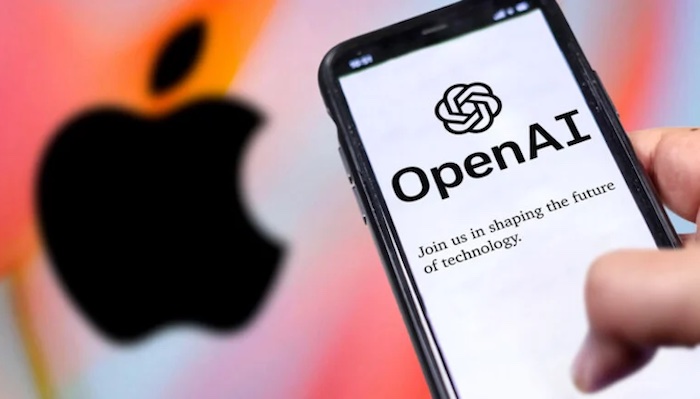
Apple has filed a lawsuit against OpenAI and two former Apple executives, accusing them of misappropriating confidential trade secrets to accelerate OpenAI’s expansion into the consumer hardware market.
The lawsuit, filed on Friday at the U.S. District Court for the Northern District of California, alleges that OpenAI carried out a coordinated effort to obtain and use Apple’s confidential information through former employees, recruitment activities, and supplier relationships. According to Apple, the alleged actions were aimed at speeding up OpenAI’s plans to develop consumer hardware capable of competing with products such as the iPhone.
In response, OpenAI denied the allegations, stating: “We have no interest in other companies’ trade secrets. We remain focused on building innovative technology that empowers people everywhere.”
The legal battle marks a significant shift in the relationship between the two companies as competition in the artificial intelligence industry continues to intensify.
Industry analysts believe OpenAI is working on a smartphone or another consumer device that could reduce its reliance on Apple’s ecosystem.
PP Foresight analyst Paolo Pescatore said Apple now sees OpenAI evolving from a partner into a potential competitor, while OpenAI is seeking to build a direct relationship with consumers instead of depending on the iPhone. He added that even if the allegations are ultimately not proven, the lawsuit could slow OpenAI’s hardware ambitions and further strain the companies’ increasingly fragile partnership.
The lawsuit names former Apple senior system electrical engineer Chang Liu and former Apple Vice President of Product Design for the iPhone and Apple Watch, Tang Yew Tan, as defendants.
Apple alleges that Liu failed to return a company-issued laptop and later exploited an authentication vulnerability to access Apple’s internal network, where he allegedly downloaded dozens of confidential hardware-related files.
The company also claims that Tan, who now serves as OpenAI’s hardware chief, systematically used Apple’s confidential information to benefit OpenAI before resigning. Apple alleges he emailed himself confidential details about Apple suppliers and internal industry reports before leaving the company.
According to the complaint, Tan also encouraged Apple employees interviewing with OpenAI to bring Apple components to interview sessions for what were described as “show and tell” demonstrations. Apple cited one applicant as allegedly saying, “I didn’t even know we could take those from the office.”
Apple’s lawsuit also names OpenAI Foundation, OpenAI Group PBC, and io Products—an OpenAI-acquired company—as defendants.
The company further claims it contacted OpenAI in February to express concerns that its confidential information had reached the AI company and requested discussions on the matter, but allegedly received no response.
Apple noted that more than 400 former Apple employees now work at OpenAI, stressing that while employee movement between companies is common, it does not give OpenAI the right to use Apple’s trade secrets to fast-track its hardware projects.
Apple additionally alleges that OpenAI employees sought confidential information from Apple suppliers, including requesting that one supplier perform a secret metal-finishing process under the impression that Apple had authorized the work.
Commenting on the case, Stanford Law School professor Mark Lemley said that if Apple’s allegations that confidential documents were taken and used by OpenAI prove to be true, the company could face serious legal consequences.
Rutgers Law School professor Camilla Hrdy added that the lawsuit may become particularly complex because most previous AI-related trade secret disputes have focused on software rather than hardware. She noted that trade secret lawsuits are common in the technology industry and that more details are likely to emerge as the case progresses.
